Lettera di aggiornamento sulla situazione a Gaza da parte della Medical Relief, nostro partner – 22 novembre 2012
November 22nd, 2012 12:00 noon After eight long days of Israeli aggression on Gaza Strip, finally a ceasefire agreement was reached. The agreement was effective as of 9:00 PM on Wednesday, Nov 21st. The aggression led to the killing of 162 people, including 42 children and injuring 1222 people including 431 children. And on the last day of the aggression, the Haidar Abdulshafi Primary Health Care Center in Jabalia sustained some damage due to the bombing near it. Some of the windows and doors were broken. The center provides services to close to 30,000 people. Services include general medicine, women health, child health, laboratory and specialists. We’d like to extend our thanks to all those who supported us during this difficult time and call upon you to continue your solidarity efforts. Below is a story from Gaza during the war On the fifth day of the Israeli aggression on Gaza Strip, PMRS medical teams started working through the emergency programs in their centers where a number of staff were able to reach the centers and start work, receiving patients and treating them. Among those received was Mrs Awatef Mohamed Alejla, 57 years old, resident of Alshejaeya in Gaza city. She came to PMRS Chronic Disease Center on Sunday morning Nov 18, at 10:00 am. She’s been a diabetic type II patient for twelve years. She came as she was suffering severe infection to her left foot which could have led to amputating a number of toes or even her foot. She started suffering from this infection since day one of the aggression, but due to the emergency situation all over Gaza’s hospitals, she could not receive any treatment at hospitals, and she started thinking about traveling abroad for treatment, but when she found out that PMRS Chronic Disease Center was operating, she came to the center. One of PMRS vehicles brought PMRS’s Dr. Tayseer Altanna, vascular surgeon, to the center where he treated the case and gave her the necessary medications in order to control the infection and save the foot. The next day, Awatef came to the center for dressing showing good improvement. On behalf of PMRS Dr. Aed Yaghi Director -Gaza Strip Palestinian Medical Relief Society Tel: +97282835990/1/2 Fax: +97282827837 Mobile:+972599412048 Email: pmrs.gaza@gmail.com Mrcgaza@palnet.com
‘Orsi su Micromega – 21 novembre 2012
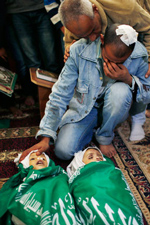
Articolo pubblicato su: http://blog-micromega.blogautore.espresso.repubblica.it/2012/11/21/angelo-dorsi-le-immagini-di-gaza/ Guardo le foto. E mi sembra un macabro scherzo. Guardo le foto. E non riesco a crederci. Le riguardo, mi soffermo sui volti color cenere, le macchie della pelle, gli occhi ora sbarrati, ora socchuisi, ora, infine, chiusi e destinati a mai più riaprirsi. Le foto dei bambini di Gaza. Quelli più grandicelli – forse 7-8 anni – sono rivesti della bandiera della Palestina, quelli più piccini, in verde islamico, con decorazioni; i neonati fasciati da lenzuolini bianchi, piccoli sudari. Guardo i volti severi, composti, pieni di dolore contenuto, dei loro genitori; una di queste immagini rappresenta un corteo funebre. Due corpicini portati delicatamente tra le braccia dei loro padri: un terzo uomo (sono tutti molto giovani), al centro, regge le teste, le piccole teste, ricoperte da un velo candido; sono i corpi senza vita di Jumana e Tamer, la cui vita è stata fermata prima che raggiungesse il quarto anno. Gli uomini camminano, non piangono, non mostrano neppure odio, ma intuisci dietro le maschere facciali, ferme, come inerti, intuisci disperazione: un’assoluta, semplice disperazione. Ma la disperazione può trasformarsi, un giorno o un mese dopo, in rabbia: una rabbia che non può avere perdono, una rabbia che nulla potrà placare. Quando ti ammazzano un figlio, una creatura di quattro mesi, o di quattro anni, come puoi accettarlo? E continuare a tacere? E quando l’assassino è il tuo oppressore, è colui che ti ha scacciato dalla tua terra, chi ha spiantato il tuo uliveto, per farci passare un muro alto come un grattacielo, chi devia il corso dei fiumi per rubarti l’acqua, chi ti costringe a quattro ore di coda, sotto il sole, per superare un punto di controllo militare, per raggiungere un posto di lavoro… Quando il colpevole è colui che sta assassinando da troppi decenni la tua gente: ebbene, come puoi chinare il capo, e continuare a subire? Quando chi ti ammazza i figli, le mogli, i genitori, chi bombarda le poche strutture di una città – Gaza City – che in un fazzoletto di terra racchiude una intera umanità, alla quale viene negato il diritto stesso alla sopravvivenza, ebbene, come puoi pensare che quelli – gli israeliani, gli ebrei occupanti che ti hanno devastato la vita e non solo rubato la patria – vogliano vivere in pace al tuo fianco? Come puoi credere che siano pronti a riconoscere i diritti del popolo di Palestina? E allora ecco che, una volta sepolti quei poveri corpi martoriati dalle bombe spesso “condite” di materiali vietati dalle convenzioni internazionali (di cui altamente la democratica Israele si infischia), la disperazione divenuta rabbia esplode; ecco la rabbia farsi essa stessa arma. Nulla può fermare quel flusso che sorge dal profondo, e non cerca altro che di venire fuori, di dirigersi contro quegli stessi che hanno assassinato la tua gente, e quando la rabbia è tanta, ma proprio tanta, diventa furore cieco. E chi ne è travolto non sta più a distinguere, a meditare, a interrogarsi su quali siano gli obiettivi giusti da colpire. Colpisce e basta. E quando non hai altre armi anche il tuo stesso corpo può diventare tale. Il kamikaze non è come scrisse in un libretto sciocco Enzserberger il “perdente radicale”. Il kamikaze è l’umiliato che prova a conquistare un’estrema dignità. Non è un vile: vile è il cecchino, è colui che mette la bomba nel cestino, o lascia una valigetta con il tritolo e si allontana e muove un congegno quando è al sicuro, e uccide, alla cieca. Non è un frustrato che vuole passare alla storia: è un disperato che preferisce la morte, dando la morte, piuttosto che accettare la “morte lenta”. Edward Said, dopo una visita a un campo profughi palestinesi, proprio nella Striscia di Gaza, scriveva: Il campo di Jabalya è il posto più spaventoso che abbia mai visto. I bambini che affollano le sue viuzze non lastricate, caotiche e piene di buche, hanno negli occhi una luce che contrasta nettamente con l’espressione di tristezza e sofferenza infinita stampata sui volti degli adulti. Non esiste una rete di fognature, il fetore dà il voltastomaco, e ovunque si volga lo sguardo si vede una massa di persone vestite di stracci passare con apparente indifferenza da un’occupazione a un’altra. Le statistiche sono terribili: il tasso di mortalità più elevato, la maggior percentuale di disoccupazione, il più basso reddito pro capite, il maggior numero di giorni di coprifuoco, l’assistenza medica più carente e così via. […] Nelle due ore passate con quegli uomini non ho colto una sola nota di speranza. Uno di loro, senza la minima traccia di autocommiserazione, parla dei suoi diciassette anni di prigione, del bambino malaticcio, dei genitori e della moglie oppressi dalla malattia o dall’indigenza, con qualche raro momento di sollievo. C’è molta rabbia. Un’espressione, che ricorre continuamente, mi rimarrà impressa per sempre: «mawt bati», morte lenta. Torno alle immagini: una mi colpisce forse ancora più delle precedenti. Una stanza, foderata di tappeti, su uno dei quali una creaturina ricoperta di un bianco lenzuolo, sul quale una macchia rossa, ti fa capire che quel bimbo (Yhad, un anno) non dorme e non è morto di morbillo. È stato ucciso. Accanto a lui, a distanza di circa un metro, suo padre. È accoccolato sul tappeto. Ha lo sguardo sperso. Come a cercare qualcuno che gli parli. Aspetta una parola: non di conforto, ma di spiegazione. Che gli spieghi perché quella creaturina, di cui si intravede il volto semicoperto, bianchissimo, è stata strappata alla vita. Ma in fondo, dentro di sé, quel giovane padre, forse preferisce per i suoi bimbi, come per se stesso, anche la morte a quell’altra, la “morte lenta”, forse meglio la tragedia della morte improvvisa, violenta, al dramma dell’attesa, la morte che si consuma giorno dopo giorno, senza possibilità di salvezza, in una vita che vita non è. I governanti israeliani, a quanto pare, sono misericordiosi. E stanno provvedendo a sostituire alla morte lenta, quella della fame e della miseria imposta dalla loro politica a una terra ricca
Commenti sul cessate il fuoco 22 novembre 2012
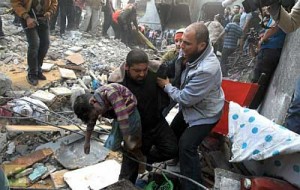
How the BBC whitewashed Israel’s war crimes from the ceasefire in Gaza http://stopwar.org.uk/index.php/palestine-and-israel/2067-how-the-bbc-whitewashed-israels-war-crimes-from-the-ceasefire-in-gaza 22 November 2012 The Editors Rarely would a state get such an easy run from the media after killing so many civilians, many of whom were children, in what the BBC now calls the ‘flare-up’ of violence. By The Editors News Unspun 22 November 2012 LAST NIGHT A CEASEFIRE came into effect after a week of attacks on Gaza which left over 150 Palestinians dead (at least 40 of them children) and rocket fire into Israel which left 5 Israelis dead. Before the news of the ceasefire became the front-page headline on the BBC News website, the headline story for the entire day concerned the bus bombing in Tel Aviv, which injured 21 civilians. Luckily this attack did not result in civilian deaths, however it was still deemed more newsworthy than the 13 Palestinians in Gaza who were killed by air strikes that same day. The news coverage was another glaring example of the different value assigned to life by our media, depending on which side of the Gaza border it resides. When this round of violence began, William Hague, UK Foreign Minister, said in a statement that ‘Hamas bears principal responsibility for the current crisis. I utterly condemn rocket attacks from Gaza into southern Israel by Hamas and other armed groups’. This followed the killings by Israel of 20-year-old Ahmad al-Nabaheen on 5 November, a 13-year-old boy as he played football, and the Hamas head of military. Yet the BBC News reports immediately represented Hague’s narrative faithfully, to the detriment of balance and historical perspective. Sixteen people were killed in Gaza that day alone, yet the BBC front-page story was ‘Gaza missiles fired at Tel Aviv’. The bus bombing yesterday, 21 November, which left ‘three people needing surgery’ served as a symbolic story, one which fitted the previously propagated assumptions perfectly: that there is one aggressor in this conflict, and it is not Israel. Readers and viewers were again told the story of Israel defending itself; in other words, the official narrative as put forward by Netanyahu, Hague, Obama and Clinton was again relayed. As Mehdi Hasan told BBC World Tonight on 19 November, ‘Israel has a bit of a pass from the western media’ and despite being the ‘stronger, more powerful, oppressive side’ is ‘portrayed as the victim’. Now that the ceasefire has come into effect, how does the BBC describe what has happened during the last week? For a start, before the news page mentions the fact that Egypt brokered the deal, a video of Netanyahu giving a speech is shown, with a quote from his speech in the caption: ‘some citizens expected a stronger military operation’. It seems to suggest that task of bringing peace, and avoiding a ‘stronger military operation’ is the work of the Israeli Prime Minister, a notion backed up further down in the article: ‘US President Barack Obama praised the Israeli leader for accepting the deal’. The article’s sole sub-headline near the start of the article summed up the western media’s almost one-sided view of the conflict: ‘Stop rocket attacks’. For such a significant news story regarding the conflict, many of the important details are buried at the end of the article. For example, at the start we are told that ‘at least 157 people have died since the flare-up of violence began last week’. The breakdown of deaths on each side is not given for another 22 paragraphs, and the violence ‘flare-up’ is not explained for 20 paragraphs. Given the day-long coverage of the bus attack, and the emphasis on rockets all week, the reader might get the impression of a fair fight, when casualty numbers indicate anything but. Other points in the article raise important questions – why is the word ‘attack’ never used in relation to Israeli actions? If 40 Israeli children had been killed, and the Israeli prime minister’s home and offices were targeted by Hamas, would this just be referred to simply as ‘hostilities’? ‘In Jerusalem tonight, Israel’s Prime Minister hinted at more severe military action if the new ceasefire doesn’t hold’, we were told in the televised news on the ceasefire. It is yet another example of BBC journalists not holding a critical eye on power, like last week when Jonathan Marcus wrote of Netanyahu’s ‘choice’ to establish a ‘policy of targeted killings’. Now, Netanyahu may flippantly ‘hint’ at ‘more severe military action’ without scrutiny applied to the praise of his ‘peace-bringing’ role offered by Obama et al. When questioning the unconditional support shown by western leaders for the government of Israel, one can find that it has little to do with offering support for Israel’s ‘right’ to ‘defend’ itself and everything to do with imperialism in the Middle East. The Israeli paper Ha’aretz wrote in September 1950 that: Israel is to become the watchdog. There is no fear that Israel will undertake any aggressive Policy towards the Arab states when this would explicitly contradict the wishes of the US and Britain. But if for any reasons the Western powers should sometimes prefer to close their eyes, Israel could be relied upon to punish one or several neighbouring states whose discourtesy to the West went beyond the bounds of the permissible. And to this day the logic applies. As As’ad AbuKhalil wrote on 14 November, ‘In a few weeks, Israel bombed Sudan, bombed Syria, and bombed Palestine and kidnapped a Lebanese shepherd’. Israeli threats towards Iran are also symptomatic of the role of the state referred to by Noam Chomsky as the ‘Middle East Policeman’. During the last week, BBC’s journalists in Gaza have provided an exceptional level of reporting throughout the conflict, their twitter accounts a valuable resource in keeping up-to-date with events inside Gaza. This standard, however, does not extend to the reports on the BBC website, which instead rely heavily on the rhetoric of ‘officials’ and politicians. It is interesting to contrast this with a simple note from BBC
intervista de “Il fatto quotidiano”‘ospedale Shifa di Gaza – 21 novembre 2012
http://tv.ilfattoquotidiano.it/2012/11/21/gaza-dentro-lospedale-di-shifa- usate-armi-non-convenzionali/211660/
Lettera di aggiornamento sulla situazione a Gaza da parte della Medical Relief, nostro partner – 21 novembre 2012
Tuesday November 21st, 2012 12:00 As the Israeli aggression on Gaza strip continues, Dr. Mustafa Barghouti, President of the Palestinian Medical Relief Society, arrived in Gaza on Tuesday November 20th, heading a medical team that came to support the work of medical and emergency services in Gaza. Dr. Barghouti and the accompanying delegate arrived through the Rafah crossing borders. During his visit to Al-Shifa Hospital, Dr. Barghouti said that “the work medical teams in Gaza are doing is heroic. They are the unknown soldiers of humanity. He added that the Palestinian Medical Relief Society and all its teams insist on carrying out their important role in Gaza and the West Bank”. So far, and after eight days of continued Israeli aggression, 139 people were killed including 34 children and more than 1200 people were injured including 381 children. We appreciate all solidarity actions and urge all of you to continue your support of our just cause. On behalf of PMRS Dr. Aed Yaghi Director -Gaza Strip Palestinian Medical Relief Society Tel: +97282835990/1/2 Fax: +97282827837 Mobile:+972599412048 Email: pmrs.gaza@gmail.com Mrcgaza@palnet.com
Lettera di aggiornamento sulla situazione a Gaza da parte della Medical Relief, nostro partner – 20 novembre 2012
November 20th , 2012, 12:00 · In a clear show of disregard to all international laws and conventions, Israeli warplanes bombed the Jordanian Field Hospital in Tel Alhawa area (Gaza city) with two missiles. The hospital, operated by Jordanian staff, has been providing health care services to Palestinian patients and injured since the previous war in 2009, sustained major damage. · We in the PMRS condemn the Israeli attack on the hospital as it shows that Israel is deliberately targeting health facilities especially since the location for this hospital is well known to them. · And in a related topic, a medical team of seventeen doctors from the West Bank, led by head of the Medical Syndicate there, arrived into Gaza. The team has a number of specialized doctors who are going to help the medical teams in Gaza provide services to the injured. · For the second day in a row, Abu Ta’ema Health Care Center in South Khan Younes still has no water, electricity, phone line or Internet connection. Below is a story from Gaza during the war Israel kills a child with disability Mahmoud Raed Sa’adallah, from Jabalia, four years of age, was killed on Friday November 16th when an Israeli missile hit him in front of his house. The missile that killed Mahmoud also killed another man, and injured five other people. Mahmoud was playing with a number of his neighbors when his mother called him to come inside. He refused, so his older brother carried him inside the house. Mahmoud left the house again and walked out to continue playing. At that point he was hit by a missile and was killed. Mahmoud suffered difficulty of movement and was part of PMRS Community Based Rehabilitation program and had received some assistance from PMRS. On behalf of PMRS Dr. Aed Yaghi Director -Gaza Strip Palestinian Medical Relief Society Tel: +97282835990/1/2 Fax: +97282827837 Mobile:+972599412048 Email: pmrs.gaza@gmail.com Mrcgaza@palnet.com
‘associazione Hanan, nostro partner a Gaza – 19 novembre 2012
Friends, comrades, brothers and kind people The people in Gaza are calling you among the sprawling corpses on the hospitals corridors The situation is crises, since the black Thursday 15.11.2012 the independence day of Palestine, at Shifa hospital there were mothers, fathers looking for children, looking for relatives. Everyone was confused and seeking support. Mothers were crying, people were asking about relatives, the medical team was confused. Some people were just lying there, some were screaming, some were very, very angry. There were a lot of injured arriving, ambulances coming in and out. The injured were coming by private cars and they were being left wherever. You could see blood here and there. There is talk [the Israeli air strikes] were targeting military persons well known to them but in Shifa hospital, you can see many, many civilians, some dead, some injured, some were children, some were women, some were elderly people. There are people without their legs in very severe pain. The doctors and nurses were trying to give them painkillers and to keep them alive. Patients are lying there knowing they’ve lost their legs. Some were asking God if they could die. They were in a terrible psychological state. This is one picture from the hospitals, if you go to streets you can see the destroyed houses everywhere, people crying on the streets, some of families are losing 2-5 of their kids, the sadness cover all the weather. OH God Gaza Strip which suffer from hard siege since 2007 are now under heavy shelling without any … Know it’s your time to support us whatever you can, kind word enough for alleviate the broken hearts of mothers and children. Hanan association children target group from the Middle area are appealing your kindness to stand beside them, they will never forget you’re removing of their tears. Hanan association Nuseirat Camp, Middle area Gaza Strip Tel-fax: +972-8-2554630 Mobile: +972-599-998920 or +972-599651452 www.hanancoo.com Email: hanan_nuseirat@hanancoo.org Hanan bank accounts details: Our USD Correspondent in New JPMorgan Chase Bank, New York Swift Code: CHASUS33 ABA No. 021000021 Bank of Palestine Ltd., Branch No. 448, Bank No. 89 Swift Code: PALSPS22 Beneficiary Name: Hanan for culture & social development association Beneficiary Account No. 332627
Lettera di aggiornamento sulla situazione a Gaza da parte della Medical Relief, nostro partner – 19 novembre 2012
Monday November 19th , 2012, 12:00 am For the sixth day in a row, Israel continues its assault on Palestinian civilians in Gaza Strip. So far more than 90 people were killed and 750 were injured, mostly women and children. Israeli attacks have mainly targeted innocent civilians, mainly women, children and elderly. Not only that, but the attacks have also targeted media personnel and medical staff. Early Monday morning, four first aid workers arriving at a bombed residential home in Beit Hanoun to provide medical aid to the injured were also attacked by an Israeli air raid. The paramedics were wounded and the ambulance sustained damage. PMRS’s Abu Taema primary health care center in South East Khan Younes, which has been providing medical care to the people and has been receiving people suffering from psychological shock, has also been affected due to the continuous bombardment, and just like the rest of the village, the clinic now has no electricity, no water, no Internet and no means of communication. And as the world prepares to celebrate Universal Children’s Day on Nov 20, Israel kills innocent children in Gaza. An Israeli attack on Aldalou family home on Sunday 18th Nov killed at least eleven members of the same family, including five children, and three women. Israeli air raids continue, and people who were waiting for the winter and expecting rain to fall from the sky are now taking shelter as it is raining missiles. On behalf of PMRS Dr. Aed Yaghi Director -Gaza Strip Palestinian Medical Relief Society Tel: +97282835990/1/2 Fax: +97282827837 Mobile:+972599412048 Email: pmrs.gaza@gmail.com Mrcgaza@palnet.com
Lettera di aggiornamento sulla situazione a Gaza da parte della Medical Relief, nostro partner – 18 novembre 2012,
Sunday November 18th, 2012; 12:00 am For the fifth day in a row, Israeli aggression on Gaza Strip continues. At least 52 people were killed, including 14 children, 3 women, and 3 elderly people, and 550 were injured, including 150 children. In a dangerous development, Israel bombed two buildings that have a number of media offices, local, Arab and international offices, injuring at least six journalists, one of them lost his leg due to the bombing. Also on Sunday, Israel bombed empty land that is adjacent to European Hospital, the biggest hospital in southern Gaza Strip. The bombing caused huge damage and destruction to the hospital. Earlier on Saturday morning (November 17th), a first aid worker attempting to provide medical help to a number of injured people in the city of Rafah, Awad Alnahhal, was killed when Israeli war planes bombed him as he tried to help the injured. We’d like to thank all those who are standing by our side and who organized solidarity activities in their countries. We call them to continue these activities and also invite them to come to Gaza to see the real situation on the ground. On behalf of PMRS Dr. Aed Yaghi Director -Gaza Strip Palestinian Medical Relief Society Tel: +97282835990/1/2 Fax: +97282827837 Mobile:+972599412048 Email: pmrs.gaza@gmail.com Mrcgaza@palnet.com
Lettera di aggiornamento sulla situazione a Gaza da parte della Medical Relief, nostro partner – 16 novembre 2012
Dear friends, Greetings from Gaza On behalf of the PMRS team, I’d like to thank all those who called or e-mailed us to show their support and solidarity with our people. Today is the third day of the Israeli offensive. So far ( until now) 24 people, including 8 children, 3 women’s were killed and 270 people including 148 women and children were injured. There is a direct hit to residential areas, and civilians are not safe in their homes. We will be sending you regular updates from Gaza. On behalf of PMRS Dr. Aed Yaghi Director -Gaza Strip Palestinian Medical Relief Society Tel: +97282835990/1/2 Fax: +97282827837 Mobile:+972599412048 Email: pmrs.gaza@gmail.com Mrcgaza@palnet.com